This video is from Robert Carlson who competed in the 2008 Extreme Mustang Makeover challenge
I found the video on his blog, and it was soo funny I had to share.
Here Robert is de-sensitising 'Artista' to sudden movements etc. And they sped the video up just for fun :)
Wednesday, February 11, 2009

Tuesday, February 10, 2009
Chip 4yo POA Gelding
 One of our many success stories!
Chip is a Pony Of America (POA) gelding, standing at a whopping 12.2 hands. He was surrendered in June 2008 with his pasture-mate Dude. Chip came in with a BCS of 2, Dude with a BCS of a 1.5. I would consider them both emaciated. First of all, how do you starve a POA? In my experience they are a very hardy breed, and very easy keepers. His background was a little sketchy, he was surrendered by a woman who claims to have rescued them from a 'crack house' type of situation. She then quickly realized she could not care for them due to lack of resources and facility--a small dirt hotwired paddock in a group of trees was all she had, much to small for three horses. When she tried to reach out to various rescues she was turned away due to lack of space. SAFE collected donations and had Dr. Hannah examine the horses, and a kind hearted person donated a few bales of hay. Eventually the horses were forwarded to me, and having learned to ride on a cute little POA, I decided Chip may be a good prospect for my lesson program.
 June 2008 with his pasture-mate Dude. Chip came in with a BCS of 2, Dude with a BCS of a 1.5. I would consider them both emaciated. First of all, how do you starve a POA? In my experience they are a very hardy breed, and very easy keepers. His background was a little sketchy, he was surrendered by a woman who claims to have rescued them from a 'crack house' type of situation. She then quickly realized she could not care for them due to lack of resources and facility--a small dirt hotwired paddock in a group of trees was all she had, much to small for three horses. When she tried to reach out to various rescues she was turned away due to lack of space. SAFE collected donations and had Dr. Hannah examine the horses, and a kind hearted person donated a few bales of hay. Eventually the horses were forwarded to me, and having learned to ride on a cute little POA, I decided Chip may be a good prospect for my lesson program.
 My first impression of Chip was that he had been handled well in the past. He was easy to catch and load, and didn't bat an eyelash at our first clipper session. He was pretty good with his feet, and he tied and cross tied. Where did this cute little pony fall through the cracks? I started the re-feeding process and he stayed in quarantine for the first few weeks. When I would turn him out in the arena, he would roll and leave a coating of hair and an impression of his skeleton in the dirt. This was both heartbreaking and adorable as he would get up and throw out one good buck--which was about all the energy he had.
It took about three good grooming sessions to get Chip's hair under control. And I began to start the conditioning process to get him ready to start under saddle. After two months of work and a decent foundation, I decided to turn him out to pasture and let him grow up a little. Two months of lush hilly pasture and I had a very handsome almost chunky little pony ready to focus on his education. I put a total of thirty days under saddle on him, and he even got ridden by a few qualified students.
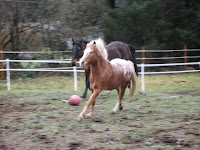
Chip was featured on the Fugly blog just before Christmas which is where his forever home first saw him. I delivered Chip and DID he win the horsey lottery! He is now very healthy and happy and  living the life of luxury. I get frequent updates and am told he is doing fantastic!
living the life of luxury. I get frequent updates and am told he is doing fantastic!Monday, February 2, 2009
Set your horse up to win

Why can't our horses win? You cannot force a horse to have a work ethic, anymore than you can force me to give up my Jimmy Choo's.
Imagine if, at your job, your boss never let you 'win'--never cut you slack, never rewarded you for good performance, was always critical and demanding, and spent the bulk of their time pointing out the negatives. Just let that sink in for a moment. You would hate your job, resent your boss, and probably become depressed and act out.
Just as a healthy and productive work environment is bred through positivity and rewarded successes, a healthy and pliable horse is won through positive and fair interaction. Instead of constantly correcting any and all bad behavior, focus on the positive.In other words, set your horse up to 'Win'. That should be your objective. You build a work ethic through success, not domination. A good horse responds to you out of trust and respect--because it wants to, not because it is forced to; because it is a partnership, not a dictatorship. It shouldn't be a struggle for power, it should be a collaboration.
Think of those phrases that were drilled into our heads as students - "you can't let your horse WIN!". Unfortunately, this sets up a false expectation that a horse and rider's relationship is always about a struggle for power, or that your horse would only respect your authority through dominance. This has lead to confusion about being a good leader and partner to your horse. Believing that you dominate through force in order to succeed, the notion is perpetuated that 'beating' your horse into submission is necessary.
This is not the case -- good leadership is about respect. Gaining your horse's obedience through 'dominance' and gaining your horse's obedience through respect are two completely different things. The difference? Fear versus choice. A horse ruled by 'dominance'1 responds out of fear. They may work hard because they fear you, but they're not doing it willingly, and they'll only work as hard as they have to to avoid punishment. This does not necessarily mean they are learning, or learning the right things. Furthermore, this sets your horse up for consistent failure. To understand why this is the case, we need to understand how a horse thinks and responds to positive and negative influences.
Horses are prey animals, and we are predators. We are wired differently so we think and respond differently. A horse is not struggling for dominance, but for survival--that is your horses primary objective: To survive. They need fair, consistent leadership in order to trust you. For a horse, trusting you means they have to willingly hand you their life and choose to work for you. When you handle a horse unfairly or are aggressive for what may seem to them as no reason, they quickly lose all respect and become defensive, concluding that you cannot be trusted and are dangerous; therefore, they should flee and/or protect themselves in order to survive. The last thing going through their head during a fight is "I should hand my life over to this person and 'submit' to them". Only when your horse trusts you will he choose to stay and cooperate in order to learn. If you set your horse up to 'win', it encourages them to choose it and earns trust.
The other difference in the two methods of relating to horses is connection. While you can possibly obtain the behavior you want through fear, you lose connection. If your horse is unable to flee physically- it will certainly flee mentally, resulting in a disconnected response. If your horse does not choose to stay, he will choose to go physically- or mentally. In contrast, respect is something you earn, and you earn respect through trust. You gain your horse's trust by respecting your horse, and by being a fair and consistent leader. Thus, your horse is able to stay connected both physically and mentally because they trust you, and their behavior is of their own choice. It's a 'win-win' situation!

On the flip side, your horse will not respect you if you allow him to just 'walk all over you'. I'm not advocating that you just baby or 'love' your horse through every behavior. The key is fair and consistent discipline, balanced with positive reinforcement. You are your horse's partner, not their drill sergeant. Therefore it is important to choose your battles, as well as putting the bulk of your energy into positive reinforcement, by focusing on what you want out of your horse. If you pick a behavior to work through be prepared to stay consistent with that decision, and keep in mind that you don't need to go overboard to make your point - use as little pressure as possible, but as much as necessary. It is better to make a point and be done with it than it is to nag. Of course, the amount of pressure will depend on the situation. If my horse steps into my space I am not going to 'kill' him, I am going to immediately ask him to take that step back. If my horse bites me I am going to 'kill' him - or make him think I am considering it. Remember that golden three second rule--make your point and that's it--you are not allowed to cause any harm to the horse.
I want my horse to come to class and be ready to focus, and willing to learn. When I pick up that lead rope or rein, I want my horse soft, supple, and relaxed in my hand. I want my horse to be asking me, "what can I do?". I will only achieve this when my horse chooses to submit to me out of respect for my leadership, not because I have bullied him, dominated him, or beat him into submission. I will achieve this through focusing positively on what I want out of my horse, in fairness and consistency. So I encourage you--to get the most out of your horsemanship experience and the most out of your horse, only put energy into what you want. Set your horse up to succeed and you both win.
1. Dominate is used here in the context of brute force and intimidation. Dominance is not achieved correctly through this kind of 'domination'.
Monday, January 5, 2009
Nadia APHA mare
It was a gloomy December day when I met Nadia. A friend at our barn had seen her ad on CraigsList and called the owner.
"Catch her and you can have her".
Of course, I volunteered to help. We drove out to a local performance barn. It was clean and all of the horses looked nice. "She's in the back" was the only help her owners offered. Nadia's pasture was the manure pile.


"Catch her and you can have her".
Of course, I volunteered to help. We drove out to a local performance barn. It was clean and all of the horses looked nice. "She's in the back" was the only help her owners offered. Nadia's pasture was the manure pile.


She was standing almost knee deep in filth, eating on filth, with a halter partially embedded in her face, and two lead ropes trailing in the mud. She stood on alert as we approached. I was given the usual warnings: She was "CRAZY" "un-trainable" and "dangerous". Sounds like fun! She was very fearful and flighty and she watched my every move as I trudged out through the mud. I immediately began a 'conversation' with her, and to my surprise she was eager to talk. Reportedly it always took a group of people and several hours to catch her. But nobody told her that, because she allowed me to walk up to her and take the lead rope after a mere thirty minutes of debate. Trembling, she cautiously followed me out of the pasture. At this point her owner had appeared, which was just the motivation she needed to RUN into the open trailer.
I had to cut the halter off of her, and carefully removed the embedded pieces. The next day, it took me about an hour to get her to relax and just let me pet her. By the end of the second day I could stand in the stall without her trembling, and touch her without her throwing herself into the wall. What happened to this mare?
My friends did some sleuthing and we found out that Nadia had been started as bucking stock, and when she didn't want to buck, they reportedly used her for roping practice. She had the scars to prove it. It was no wonder she was terrified of people. I worked the next week on haltering, leading, catching, and letting me touch her. The first roundpen session we had some major breakthroughs. She wanted so badly to have contact, but every instinct, memory and experience in her told her I was going to hurt her, and she needed to flee.
By week two she was haltering, leading, and allowing me to catch her out of the roundpen without any major drama . She would let me walk up to her and stroke her neck without shaking.
Now, a brush was a different story. Nadia was incredibly sensitive - the wrong body language would send her into a tizzy, and brushes were foreign instruments of torture. But she was a hairy, dirty, and very skinny yak, and I could not stand the 'goat hair'. She eventually endured having her mane cut, brushed out, and her hooves picked, but even though she stood like a pro for the torture she sweated profusely. We worked hard through the following months to get through major trauma.
Slowly she became a much more relaxed and well adjusted horse. We could at least handle her like a normal horse. I began saddle work, which is where the bucking stock came out. I got to where you could tack her up, lunge etc. without an issue. But the sound of the whip would trigger blind bucking. I mean BLIND. She would crash into walls, gates, and through or over whatever happened to be in her way. After being dragged across the arena, thrown into a wall, and several third degree rope burns I gave up trying to hold onto her and let her work it out. She would snap out of it as if she had been in a total trance, and then trembling she would come back to me exhausted. I was able to successfully work through this trigger and de-sensitize her to ropes, whips, and tarps etc. At this point Nadia was adopted by a knowledgeable person, who was willing and able to continue her training. Although I have always wished I could have finished her training, Nadia is fat and happy in her forever home, and I am thankful that I had the opportunity to be a part of her journey.


Sunday, January 4, 2009
It all started with a little 'Hope'
This is the story of how I found my passion in horses, and the little QH mare who started it all.

I met Hope in March of 2003. Standing knee deep in mud, emaciated and with hardly any hair from severe rainrot. It was love at first sight. Weak, wormy, and covered in sores I bought Ms. Hope for $200. My trainer was furious.
A few tubes of wormer, and several vet bills later, a spunky little filly emerged. Hope was headshy from the beginning, but I had been making progress. It wasn't until she started getting healthy we realized how fearful she was. If you raised your hand to your eyes, instead of flinching she would stretch out and prepare to defend herself. I had never dealt with an abused horse, let alone a defensive, and somewhat aggressive one. Leading became a stressful venture, and soon I couldn't even go into the stall with her without dodging double barrel kicking, charging, and rearing. If you could catch her to take her out, she would lead fine for a few strides and explode without warning. First pulling back violently and trying to bolt, then rearing and striking at you. I was told to carry a dressage whip and get a stud chain. This was all I knew so I tried it. The first time I struck her across the knees with the dressage whip, she flipped over backward tore out of my hands and charged me. This was not going to work.


I met Hope in March of 2003. Standing knee deep in mud, emaciated and with hardly any hair from severe rainrot. It was love at first sight. Weak, wormy, and covered in sores I bought Ms. Hope for $200. My trainer was furious.
A few tubes of wormer, and several vet bills later, a spunky little filly emerged. Hope was headshy from the beginning, but I had been making progress. It wasn't until she started getting healthy we realized how fearful she was. If you raised your hand to your eyes, instead of flinching she would stretch out and prepare to defend herself. I had never dealt with an abused horse, let alone a defensive, and somewhat aggressive one. Leading became a stressful venture, and soon I couldn't even go into the stall with her without dodging double barrel kicking, charging, and rearing. If you could catch her to take her out, she would lead fine for a few strides and explode without warning. First pulling back violently and trying to bolt, then rearing and striking at you. I was told to carry a dressage whip and get a stud chain. This was all I knew so I tried it. The first time I struck her across the knees with the dressage whip, she flipped over backward tore out of my hands and charged me. This was not going to work.

At this point no one at my barn would touch Hope, and handling her was frustrating to tears. In desperation I began to look for more help, and abandon the notion that my trainer knew all. I started studying John Lyons, Ray Hunt, Buck Brannaman, and Monty Roberts. A natural horsemanship trainer moved to my barn to expand her lesson program. Seeing my frustration, she offered to help catch and lead Hope. I was SO relieved I asked her if she could do anything with the filly. Forty five minutes in the roundpen and Hope's eye began to soften. That was the first time I saw her "lick and chew". Watching the relationship form between them, the subtle almost imperceptible communication, began to radically change the way I thought about horses. I had never seen anyone handle a horse in this way. It was always "my way or the highway", you have to "win" every "fight", and drill a horse until you worked out all the kinks. Could I really communicate with my horse? Without force?
I audited every lesson, and training session I could. I cleaned stalls to pay for lessons. And I started to build respect, trust, and a solid relationship with my horse. I soaked up anything I could whenever I could. Countless clinics, books, DVD's, and lessons later. I had a safe, easy to handle, sane and happy horse. She would have walked through fire for me. Any chance I had to learn something new, or from someone new, I jumped at it. As i mastered the skill, and began to understand the theology and psychology behind, it I only wanted more. I started helping friends with their horses, and soon I got a job re-starting OTTB's for dressage. A year and a few short apprenticeships later: People started offering me money to work with their horses. I saw an opportunity to learn and support my horse doing something that I loved. Every horse offered a new challenge.
Skip ahead a few years. And I started NHS. Abandoning my desk job, I took a leap of faith and made horse training my full time job. Not long after taking this step I changed my focus from training, to education. I launched my lesson program with the goal to "Educate the next generation of horsemen." My passion is teaching, training, and rescue. And my program operates to support my rescues. Every one of my lesson horses has a story. After rescue and rehabilitation, I train them and put them in my lesson program. The are then placed, hopefully with a student. And the cycle continues. The average horse spends a year and a half in my program before I put them up for adoption. Horses who are not good prospects as lesson horses, are placed after their rehabilitation is complete.
Hope has a forever home with me, I promised her that the day I bought her. She will always challenge me to be a better rider, a better trainer, and a better person. It has been a journey so far, and I expect that will never change.

Friday, January 2, 2009
Dixie the TB
Dixie's owners were at their wits end. They had purchased Dixie off of craigslist as a child-safe family horse, they even rode her before buying (she was reportedly dripping with sweat and already saddled when they arrived). When they got Dixie home you couldn't put a saddle pad on her, let alone a saddle without violent blind bucking. The owner had reportedly been deployed to Iraq, so they called Pilchuck. After several visits, and extensive chiropractic work etc. the vets at Pilchuck diagnosed it as a training issue and not pain related. After investing more than they could afford they called my friend Katie at Second chance ranch. Katie called me so I could evaluate the mare.
Dixie was so sweet when I did her eval. she was easy to catch, and had a kind eye. I put my arm over her withers and she held her breath, I applied pressure to her ribs and she launched herself into a bucking fit. This did not seem like merely a training issue. Still I put a saddle on her to try and get a feel, assured that the vet said she was in NO pain. She stood to be saddled, after a small correction, but held her breath. I asked her to take a step and she looked at me as if to say "I can't", I persisted and she finally tried for me but with one step she almost hit the floor and then launched into bucking. OK she tried but she is hurting. I told the owner I would take her for a few months, put some training on her and have some body work done.
Dixie was definitely OUT. her ribs were out so bad Sam couldn't even test her. Not surprising after finding out more of her history. She had been a brood mare for the past seven years with minimal care, a friend who recognized her and knew the past owner testified that she had never seen her without her hip bones showing, and she was never saddle broke.
Kids horse?
Dixie's first month here was mostly healing. I did some ground work, mostly just to start conditioning her. Free lunging was my only option as we worked through her pain issues, but she did well responding to cues and learned to be very respectful. It took a lot to get a 'WHOA'. But by the end of the month she would whoa on a voice cue. I started clicker training basics to lay a foundation for her saddle training. As with most of the trauma cases I have worked with I will be using clicker training to redirect her, and put a focus on a positive behavior. I never punish a traumatized or emotional horse for the behavior I am trying to extinct, this only reinforces the behavior. Instead you have to redirect and reward for something positive, this is the only way to break the whole emotional mindset the horse is in. Remember to only put energy into the behavior you want.
Month two; after I was confident she really was no longer in any pain I started desensitizing her to the surcingle, even just the lead rope around her belly. As soon as she would feel constricted (like it would pinch) she would flip. Ok I knew her trigger, now to work through it!
After two weeks of lungework she would still buck like crazy if ANYthing was on her back or around her. She would literally buck blind as soon as her trigger was hit. I couldn't snap her out of it or redirect her, she was to fast and powerful. I needed a new plan. I finally found a tool, well I made one, to get her attention whenever she would think about bucking. It is basically an overcheck (saddleseat tool to keep their heads up) slightly modified. I wasn't to sure about it at first, but it halted the behavior before it had a chance to escalate, and while she was going "WTF?" I was able to redirect and click her for a positive change. FINALLY I was making some serious progress! Through the following month I continued to use this tool while lunging and riding, then just lunging. And now finally I can tack her up in the crossties, lead her to the arena, lunge her and get on and go.
Month Three:
Dixie's owner decided not to put anymore training into her, but I talked them into just boarding her and I would try and ride when I could. Her third and fourth month she didn't get a lot of riding, but I did get Kyra to ride her a couple of times. And the few rides I put on I couldn't MAKE her buck. WOW with time off she was still solid! That goes to show the reliability of positive reinforcement.
Well it has been almost five months and Dixie is going home. Her owner is going to come out and ride her on Tuesday and then I will trailer her up the next morning. I rode her tonight and she was great, she has such a nice trot, tons of suspension she would make a fun dressage prospect. She was solid for walk, trot, canter, whoa, back, leg yield, shoulders in, haunches in. She had about 40 days of riding total. And it was quite the journey!
Dixie was so sweet when I did her eval. she was easy to catch, and had a kind eye. I put my arm over her withers and she held her breath, I applied pressure to her ribs and she launched herself into a bucking fit. This did not seem like merely a training issue. Still I put a saddle on her to try and get a feel, assured that the vet said she was in NO pain. She stood to be saddled, after a small correction, but held her breath. I asked her to take a step and she looked at me as if to say "I can't", I persisted and she finally tried for me but with one step she almost hit the floor and then launched into bucking. OK she tried but she is hurting. I told the owner I would take her for a few months, put some training on her and have some body work done.
Dixie was definitely OUT. her ribs were out so bad Sam couldn't even test her. Not surprising after finding out more of her history. She had been a brood mare for the past seven years with minimal care, a friend who recognized her and knew the past owner testified that she had never seen her without her hip bones showing, and she was never saddle broke.
Kids horse?
Dixie's first month here was mostly healing. I did some ground work, mostly just to start conditioning her. Free lunging was my only option as we worked through her pain issues, but she did well responding to cues and learned to be very respectful. It took a lot to get a 'WHOA'. But by the end of the month she would whoa on a voice cue. I started clicker training basics to lay a foundation for her saddle training. As with most of the trauma cases I have worked with I will be using clicker training to redirect her, and put a focus on a positive behavior. I never punish a traumatized or emotional horse for the behavior I am trying to extinct, this only reinforces the behavior. Instead you have to redirect and reward for something positive, this is the only way to break the whole emotional mindset the horse is in. Remember to only put energy into the behavior you want.
Month two; after I was confident she really was no longer in any pain I started desensitizing her to the surcingle, even just the lead rope around her belly. As soon as she would feel constricted (like it would pinch) she would flip. Ok I knew her trigger, now to work through it!
After two weeks of lungework she would still buck like crazy if ANYthing was on her back or around her. She would literally buck blind as soon as her trigger was hit. I couldn't snap her out of it or redirect her, she was to fast and powerful. I needed a new plan. I finally found a tool, well I made one, to get her attention whenever she would think about bucking. It is basically an overcheck (saddleseat tool to keep their heads up) slightly modified. I wasn't to sure about it at first, but it halted the behavior before it had a chance to escalate, and while she was going "WTF?" I was able to redirect and click her for a positive change. FINALLY I was making some serious progress! Through the following month I continued to use this tool while lunging and riding, then just lunging. And now finally I can tack her up in the crossties, lead her to the arena, lunge her and get on and go.
Month Three:
Dixie's owner decided not to put anymore training into her, but I talked them into just boarding her and I would try and ride when I could. Her third and fourth month she didn't get a lot of riding, but I did get Kyra to ride her a couple of times. And the few rides I put on I couldn't MAKE her buck. WOW with time off she was still solid! That goes to show the reliability of positive reinforcement.
Well it has been almost five months and Dixie is going home. Her owner is going to come out and ride her on Tuesday and then I will trailer her up the next morning. I rode her tonight and she was great, she has such a nice trot, tons of suspension she would make a fun dressage prospect. She was solid for walk, trot, canter, whoa, back, leg yield, shoulders in, haunches in. She had about 40 days of riding total. And it was quite the journey!
Subscribe to:
Posts (Atom)


